
Is AI Replacing Pakistani Freelancers — or Making Them Richer?
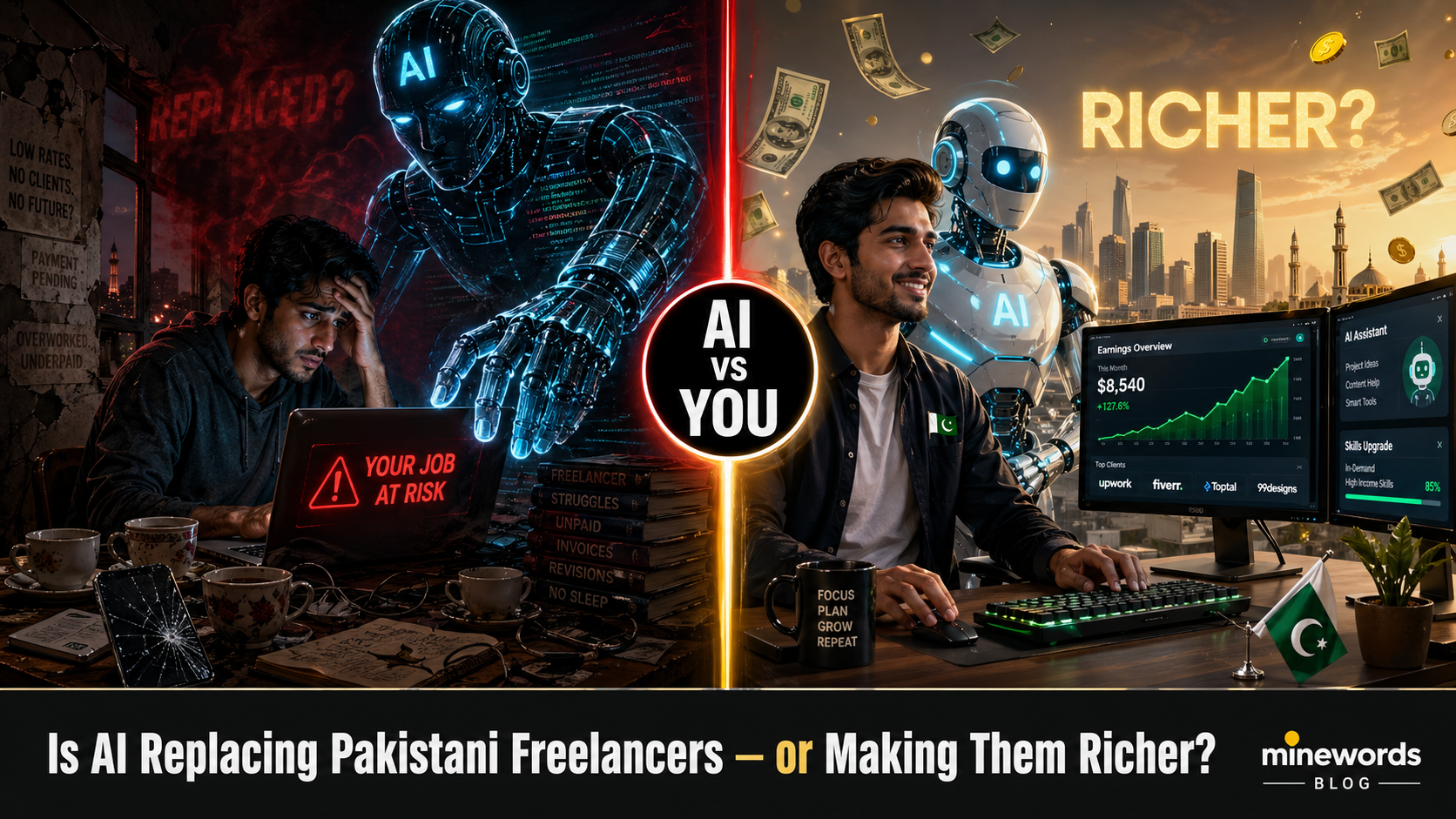
Pakistan's 2.37 million freelancers earned $856M in FY26 — a 50% jump. Yet AI is quietly gutting entry-level work. So is AI your biggest threat or greatest opportunity? The honest answer will surprise you.
$856M Earned in 9 months FY26
+50% Year-on-year growth
2.37M Pakistani freelancers
−21% Jobs lost in AI-exposed roles
Let's start with a number that should make every Pakistani proud and a little uncomfortable at the same time. According to the State Bank of Pakistan, Pakistani freelancers earned $856 million in foreign exchange in the first nine months of FY2025–26. That's a 50% jump over the same period last year. By any measure, that's a booming industry.
Now let's sit with a second number. Fiverr — the global platform that millions of Pakistani freelancers depend on — has shed over 60% of its stock value in the past year. It trades below its 2019 IPO price. It laid off 25% of its workforce. Active buyers dropped from 3.6 million to 3.1 million in a single year. The CEO called it a return to "startup mode." Upwork told a similar story, projecting a decline in total service volume for 2026.
How can both things be true? How can Pakistani freelancers be earning more than ever while the platforms they work on are quietly collapsing? The answer to that question is also the answer to whether AI is your biggest threat or your greatest opportunity.
The Real Damage AI Has Already Done
Let's not dress this up. Researchers at the Brookings Institution found that freelancers in AI-exposed occupations have already seen a 2% decline in contracts and a 5% drop in earnings since generative AI tools became mainstream. That's not a forecast. That already happened.
Fiverr has lost over 60% of its stock value in the past twelve months, trades below its 2019 IPO price, and laid off 25% of its workforce. Active buyers on the platform dropped from 3.6 million to 3.1 million in a single year. The reason, bluntly put, is that the clients who once hired freelancers for writing, basic design, and customer support now use AI tools instead.
Who Is Getting Hurt
Entry-level freelancers doing volume-based, repetitive work bear the heaviest load. Clients who used to pay $10 for a 500-word article are now using ChatGPT and paying nothing. Entry-level freelance work — basic blogs, product descriptions, simple data entry, generic virtual assistance — is being handed to AI at a growing rate. That income stream has genuinely thinned.
Over the past decade, Pakistan's freelance economy was widely celebrated as a success story — an accessible pathway for young professionals to earn globally without leaving their homes. By early 2026, signs of structural stress have become increasingly visible. Freelancers across major platforms are reporting declining orders, reduced earnings, and growing uncertainty.
The human cost of this is not abstract. The average affected freelancer is 22 to 30 years old, supporting a family, with no pension and no savings buffer. For women, the stakes are even higher. Freelancing enabled economic participation without commuting barriers or workplace safety concerns. With female labour force participation already limited, AI-driven job losses could weaken one of the country's most accessible channels of inclusion.
AI doesn't just threaten their earnings. It threatens the most promising path to female economic participation Pakistan has built in a generation. — Bilal bin Saqib, blockchain & AI policy expert, via Geo.tv
Then Why Are the Numbers Going Up?
Here is where the story gets genuinely interesting. According to data released by the State Bank of Pakistan, freelance export receipts increased to $557 million during July to December 2025, compared to $352 million in the same period last year — a 58% year-on-year growth. By the end of the third quarter, that figure had climbed to $856 million.
Pakistan is home to more than 2.37 million freelancers, ranking among the top countries globally in terms of freelance workforce size. Hundreds of thousands of new freelancers trained by public sector initiatives and NGOs are entering the market each month.
So the total number is up because more people are entering the market. But look more carefully and a split is emerging. A smaller group of freelancers — the ones who figured out AI early — are charging significantly more and working on more complex projects. The majority, still competing on cheap rates and basic deliverables, are being squeezed from below by a technology that works for free.
The Uncomfortable Truth
The era of winning freelance gigs by undercutting everyone else on rate is functionally over for most categories of work. Clients can get "cheap and fast" from AI directly now. What they can't get from AI alone is domain expertise, strategic judgment, and a human who understands their specific context.
The Great Freelancer Split
Think of Pakistan's freelance economy as dividing into two very different groups right now. The table below is a map of where things stand in 2026.
| Skill / Category | AI Impact | Status |
| Basic content writing, product descriptions | Fully automatable — clients use ChatGPT directly | At Risk |
| Logo design, template-based graphics | Heavily commoditised by Midjourney, Canva AI | At Risk |
| Simple data entry, virtual assistance | Automated out of existence for basic tasks | At Risk |
| Prompt engineering & AI workflow building | Created by AI — entirely new category | Thriving |
| AI-assisted software development | Productivity up 26%+ with GitHub Copilot | Thriving |
| Strategic digital marketing & SEO | Demand rising — AI can't replace judgment | Thriving |
| UI/UX design with strategic thinking | $1,000–$5,000/month, AI speeds up delivery | Thriving |
| AI model training & data labeling | Growing but low-paying, limited upside | Mixed |
The Freelancers Who Are Getting Rich From AI
Here is what the top earners figured out that most haven't yet: prompt engineering, AI workflow automation, and genuine niche expertise command three to five times the rates of generic AI-assisted output. One well-trained AI operator can now produce what a five-person team delivered two years ago. That's the leverage available to anyone who builds real skill.
A 2025 study of 4,867 developers, conducted with participants from Microsoft and Accenture, found that access to GitHub Copilot increased completed tasks by 26% in ordinary business settings. The strongest gains were found among less experienced and more junior developers. This is significant for Pakistan specifically, where the freelance workforce skews young and hungry.
The Reframe That Changes Everything
AI is giving many freelancers a path out of pure service work and into ownership. A solo developer can now ship a stronger prototype in days. A freelancer who once sold the same fix again and again can package that knowledge into something that scales. The tools have never been more democratised. A one-person operation in Lahore can now deliver what an agency in London charged ten times more for two years ago.
UI/UX design and AI-related skills — prompt engineering, automation — are among the highest paying globally in 2026, often earning $1,000 to $5,000 per month. Pakistani freelancers in these categories are not just surviving. They are winning.
The 5 Moves That Separate Winners from Victims
None of this is fate. The difference between the Pakistani freelancer who thrives in the AI era and the one who gets replaced isn't talent — it's decision. Here are the five moves the top earners are making right now.
- Stop competing on price. Start competing on expertise.
Clients can get cheap from AI. They cannot get expert strategic judgment. The move is to go deeper in one vertical — healthcare content, fintech copywriting, SaaS onboarding — not broader across everything.
- Learn to wield AI as a multiplier, not a replacement.
Pakistani content writers using ChatGPT to generate outlines and structure, then applying their own voice and cultural nuance, are delivering three times the output at the same quality. Volume becomes a weapon, not a liability.
- Add prompt engineering and AI automation as a service.
Prompt engineering continues to be one of the most in-demand AI skills in 2026. Freelancers offering AI automation services are in high demand on platforms like Upwork and Fiverr, making this one of the fastest-earning skills available. This doesn't require a CS degree. It requires practice and curiosity.
- Use Pakistan's tax advantage aggressively.
Freelancers earning in foreign currency through legal banking channels pay a maximum flat tax of just 1% on gross income — one of the most favourable freelancer tax rates anywhere in the world. Freelancers registered with PSEB pay just 0.25%. Use this edge to undercut competitors from countries with 25–40% tax rates while earning the same net.
- Move from projects to products.
AI lowers the cost of experimentation. Code, support scripts, landing pages, product copy, and internal documentation can all be built faster than before. The freelancers winning at the highest level are packaging their expertise into templates, micro-SaaS tools, and digital products — recurring income that doesn't depend on finding a new client every week.
The Structural Problems Nobody Wants to Talk About
It would be dishonest to write this article without acknowledging the things that are genuinely broken and that no amount of personal hustle can fix.
Industry bodies including the Pakistan Software Houses Association have highlighted concerns around reliability in global outsourcing markets. Even minor inconsistencies can prompt clients to shift work to more stable regions. Load shedding and internet outages aren't just inconveniences — they're credibility destroyers on international platforms where one missed deadline can tank your rating permanently.
Internet disruptions were damaging freelancer productivity, client trust, and the wider digital economy, with industry estimates suggesting losses of up to $300 million. When a country's online workforce depends on connectivity as their sole infrastructure, even brief instability carries a real national cost.
What The Government Is Actually Doing
The government has facilitated freelancers to maintain foreign exchange accounts and retain up to 50% of their income in dollars. Freelancers registered with the Pakistan Software Export Board pay a minimal tax of 0.25%. Policy reforms and partnerships with the private sector are being aligned to help freelancers integrate into the formal economy. It's a start. Infrastructure investment needs to follow.
The Bigger Picture: From Labour to Leverage
Pakistan's freelance story has always been told as a labour story — millions of talented young people selling skills to foreign clients at competitive rates. AI is forcing a rewrite of that story, and the new version is more interesting.
Pakistan does not need a fresh lesson in digital hustle. It already has millions of people earning from laptops for clients they may never meet. AI is giving many of them a path out of pure service work and into ownership. Pakistan has already secured a serious place in global digital labour. The next step is to retain more of that value through building companies on top of the existing service economy.
Sualeh Asif — the 26-year-old from Karachi who just signed a $60 billion deal with SpaceX for his AI coding startup Cursor — didn't get there by being a cheaper alternative to someone else. He got there by building something the world needed. That's the trajectory AI is now making accessible, at some level, to every skilled Pakistani freelancer who chooses to see the tool rather than fear it.
The Verdict
AI is absolutely replacing Pakistani freelancers who compete on price, speed, and volume for commoditised tasks. It is simultaneously making Pakistani freelancers who embrace it, specialise deeply, and move up the value chain considerably wealthier than they were two years ago. The $856 million in earnings proves the pie is growing. The Fiverr collapse proves the old slice is shrinking. The only question worth asking in 2026 is: which side of that split are you building toward?
Sources
State Bank of Pakistan — Freelance export receipts data, FY2026 (Q1–Q3)
Express Tribune — "Freelancers fetch $856m in 9 months" (April 21, 2026)
The News International — "Freelancers earn over $500m in 1HFY26" (February 2026)
Geo.tv — "AI is coming for Pakistan's freelancers. We need to talk about it" (February 23, 2026)
Digital Pakistan — "How to make money with AI in Pakistan (The Right Way) in 2026"
The News / Money Matters — "Pakistan's freelancers want to build" (March 2026)
TechList.pk — "Pakistan's Freelance Economy at a Crossroads" (March 2026)
Brookings Institution — Hui, Reshef, and Zhou (2024), AI impact on freelance contracts
Harvard Business School / Imperial College — "The Impact of Generative AI on Online Freelancing Platforms"
Asian Development Bank — Pakistan freelancer workforce count, 2.37M
PNY Trainings — "Top AI Skills to Learn in 2026 for Career Growth in Pakistan"
Comments